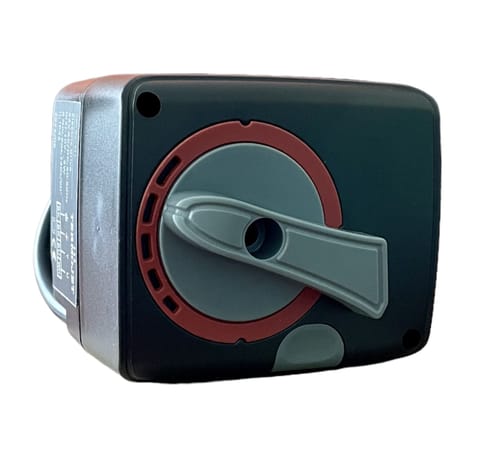

Actuator with integrated controller and sensor Termojet 230V, 3-point, 5-90°C, 6 Nm 413
Termojet 413 actuator — a unique “actuator + controller + sensor” solution in a single housing for 3- and 4-way rotary mixing valves. Supply voltage 230V AC , control type — 3-точкове SPDT , torque 6 …
per unit · payment on delivery or by invoice
Technical specifications
Description
Termojet 413 actuator — a unique “actuator + controller + sensor” solution in a single housing for 3- and 4-way rotary mixing valves. Supply voltage 230V AC, control type — 3-точкове SPDT, torque 6 Нм, full stroke time 90° — 120 секунд, protection class IP42. The built-in controller maintains the set coolant temperature in the range of 5–90°C based on built-in sensor readings — no separate controller, no programming, no additional cables. Sensor — remote, cable 5 m.
Technical Specifications
Operating Principle
The built-in controller continuously reads the coolant temperature from the remote sensor and compares it with the set value established on the actuator regulator. If the temperature is below the set value — the controller sends an “open” signal to the motor, the valve opens toward the hot flow. When the set temperature is reached — the motor stops and holds the current position. If exceeded — a “close” signal is sent. In this way, the 413 actuator independently maintains a stable temperature without any external controller, requiring only a 230V connection and placement of the sensor on the pipeline.
Applications
- Boiler room without external controller. The 413 actuator paired with a 3-way valve DN25 — a fully autonomous mixing unit without additional automation: connect 230V, install the sensor on the pipe, set the temperature — everything works.
- Solid-fuel boiler protection. Together with a 4-way valve DN32, the 413 actuator autonomously maintains return temperature above the safe threshold — without a boiler controller and without external programming.
- Modernization of old boiler rooms. Ideal for boiler rooms with a simple boiler that has no mixing control outputs. The 413 actuator handles the regulation task independently.
- Country and suburban houses. Ease of connection and autonomous operation make the 413 the optimal choice for facilities without permanent technical maintenance.
- Backup scheme upon controller failure. The 413 actuator can be used as a backup unit: if the main controller fails, the system continues to maintain the set temperature autonomously.
Advantages of Termojet 413
- Built-in controller and sensor — no separate temperature controller required: cost reduction and simplified wiring.
- Range 5–90°C — covers all modes: from boiler protection (55–65°C return) to low-temperature underfloor heating circuits (35–45°C).
- Standard 230V power supply — no transformers, direct connection to the grid.
- 5 m sensor — sufficient length for installation on the boiler or circuit pipeline.
- Clutch manual control — set position manually during commissioning without grid connection.
Actuator and Heat Pump
For systems with a heat pump, the 413 actuator can serve as a backup or auxiliary unit — for example, to maintain temperature in circuits not covered by the main heat pump controller. If your heat pump has a 0–10V analog output for mixing valve control, consider the Termojet 411 actuator (0–10V, 24V) — it will provide full integration with heat pump control. More about heat pump connection schemes — on the website of Termojet heat pumps.
Frequently Asked Questions
Actuator 413 with built-in controller — when is it needed?
When there is no separate temperature controller or when a simple autonomous “plug and forget” solution is needed. The 413 actuator independently maintains the set temperature (5–90°C) based on built-in sensor readings. Ideal for boiler rooms with a single boiler and a single mixing valve without external automation.
How does the 413 differ from the 401N and 405N actuators?
401N and 405N are “pure” actuators: they only execute commands from an external controller (open/close). The 413 actuator has its own controller with sensor: it measures temperature itself and decides on the direction of rotation. This means full autonomy, but less flexible integration with systems that require proportional or weather-compensated control from an external controller.
Product reviews
No reviews for this product yet. Be the first!
Related Products