Why Distant Radiators Stay Cold: Balancing Your Heating System
If rooms close to the boiler overheat while far-away rooms are barely warm, the problem is not boiler output — it's a lack of hydraulic balancing. We explain how to fix it with balancing valves.
The heat-transfer fluid follows the path of least resistance. Without balancing, it «short-circuits» through the circuits closest to the boiler, while those farther away receive too little flow. The result is overheating in some rooms and cold in others — even with a perfectly functioning boiler.
What balancing means
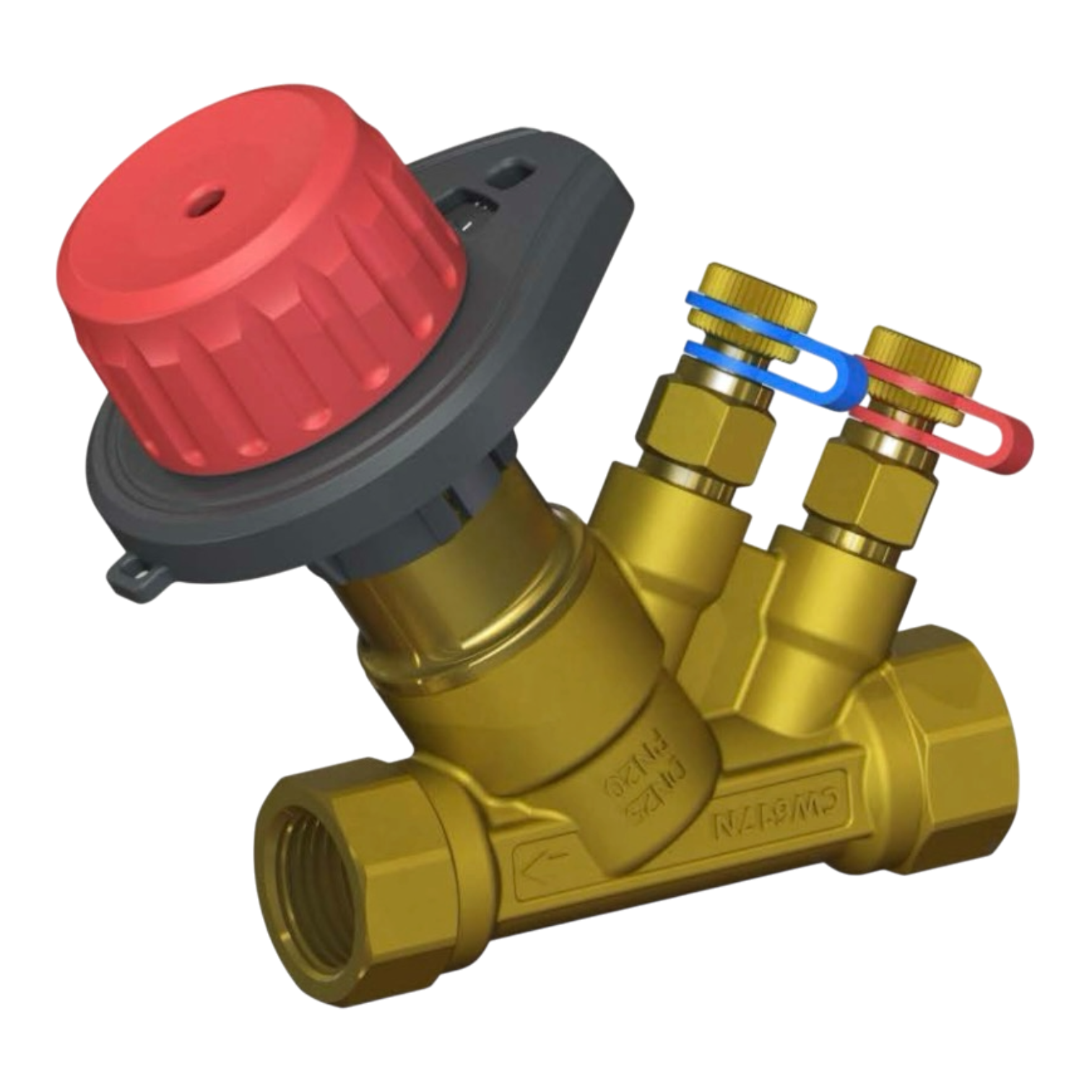
Balancing means setting the resistance of each circuit so that the flow rate matches the calculated heat output for that room. The tool for this is a static balancing valve with a defined flow coefficient Kvs.
How to set it up
Every balancing valve has a presetting scale. Using the design flow rates and the Kvs table, you set the number of turns on each circuit: distant circuits are opened further, nearby ones are throttled back. This eliminates «hydraulic imbalance» once and for all.
Underfloor heating manifolds
On underfloor heating manifolds it is more convenient to use models with built-in flow meters — adjustment is done visually using the float indicator. For radiator systems, static valves with a scale are sufficient.
The role of the pump group
In Termojet pump groups, a balancing valve is already integrated — the circuit is set to the design flow rate without any additional fittings.
Proper balancing also reduces energy bills: the boiler no longer runs at full capacity just to overheat the nearest rooms.