Flanged dirt separator Termojet DN50 110°C/10bar
Flanged dirt separator Termojet DN50 — a steel vessel for cleaning sludge out of heating and cooling systems in boiler rooms, heat substations and industrial circuits. The connection is flanged DN 50 …
per unit · payment on delivery or by invoice
Technical specifications
Description
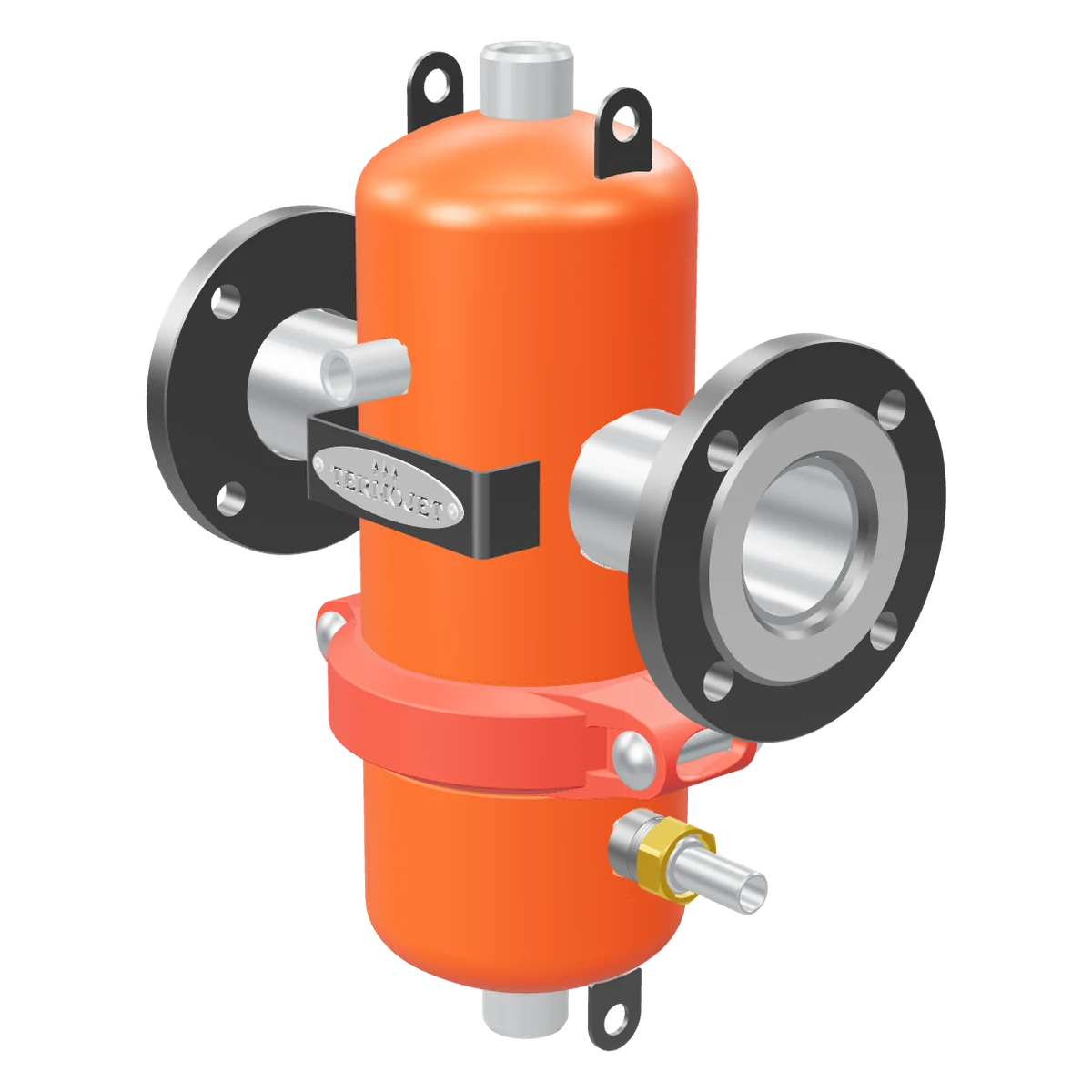
Flanged dirt separator Termojet DN50 — a steel vessel for cleaning sludge out of heating and cooling systems in boiler rooms, heat substations and industrial circuits. The connection is flanged DN 50 (GOST 12820-80, PN16, flange outside diameter 160 mm), so the unit is built into steel pipework without adapters and is removed for service without cutting.
How the dirt separator works. In the wide body the flow velocity drops sharply and particles heavier than water lose the ability to travel with it. The stainless steel spiral mesh swirls and slows the flow, knocking fine sludge — mill scale, corrosion products, sand, installation debris — into larger agglomerates. They settle into the lower collecting chamber and are drained through a valve without shutting the system down. Both magnetic and non-magnetic particles are trapped: separation here is gravitational rather than magnetic, so it works across the whole spectrum of dirt.
Why it is needed. Air in a system means cold spots on radiators and underfloor loops, noise, cavitation and premature wear of pump bearings, plus oxygen corrosion of steel. Sludge means blocked boiler heat exchangers, seized valves, worn impellers and falling heat output. A dirt separator is installed once and then works on its own: the sludge simply needs draining on the service schedule. The best result comes from a pair — an air separator on the flow right after the boiler, where the water is hottest and gives up gas most readily, and a dirt separator on the return ahead of the boiler and pumps that need protecting.
Advantages of the Termojet DN50 dirt separator:
- the spiral insert is stainless steel — it does not rust itself and never becomes a source of dirt, unlike inserts made of carbon steel;
- DN 50 flanges to GOST 12820-80 PN16 — a demountable joint, the unit comes off for inspection without welding;
- the body opens for cleaning the mesh — servicing without replacing the unit;
- a bottom sludge chamber with a drain valve — sludge is drained without stopping or emptying the system;
- minimal hydraulic resistance: the unit does not eat into the pump head;
- made by Termojet in Ukraine, manufacturer’s warranty.
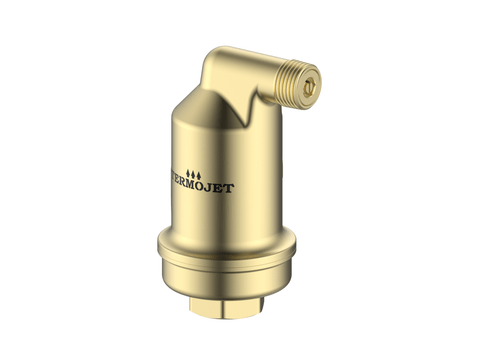
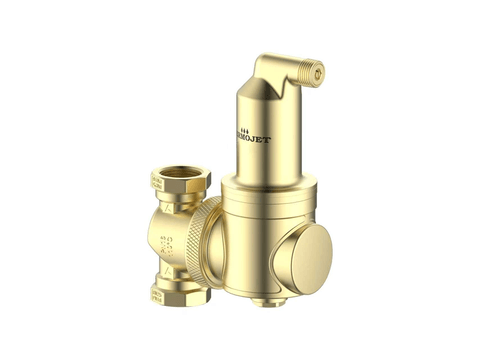
Where it is used. Boiler rooms and heat substations of commercial and industrial buildings, boiler cascades, district heating systems, cooling circuits, heat pump installations. The flanged series starts at DN50 and covers up to DN100; for smaller circuits the catalogue offers threaded models — threaded DN50 dirt separator and combined DN50 air and dirt separator. Neighbouring sizes in the same series — DN65. The full list is in the Termojet air and dirt separators section.
What it is installed with. In a boiler room the dirt separator pairs with the flanged air separator DN50 — together they remove both gas and sludge. If the scheme includes a hydraulic separator, part of this work is already done for you: the body of a Termojet low-loss header has a built-in air vent and sludge trap. Pump circuits downstream of the separators are easiest to assemble from ready-made Termojet pump groups. For heat pump installations see Termojet heat pumps.
Technical data: flanged DN 50 connection (GOST 12820-80, PN16, flange outside diameter 160 mm), branch bore 54 mm, nominal flow 12.4 m³/h at a velocity of 1.5 m/s, maximum working pressure 10 bar, maximum medium temperature 110 °C, medium — water or a glycol solution up to 50%, coalescing element — stainless steel spiral mesh, body — structural steel, dimensions 380×490×208 mm (W×H×D), mounted on a horizontal pipe with the body vertical, facing up.
Frequently asked questions
Is a magnet needed if the separation is gravitational?
A magnet picks up fine magnetite in suspension, but it is blind to sand, mill scale and non-magnetic particles, and its rod has to be pulled and cleaned regularly. A spiral mesh with a settling chamber traps the whole spectrum of dirt and is serviced by a simple drain. For circuits with a lot of magnetite a magnetic insert can be considered as an addition.
Where exactly should it be installed?
A dirt separator goes on the return ahead of the boiler and the pumps: it traps sludge before it reaches the heat exchanger and the impellers. The body is mounted vertically on a horizontal run of pipe, with free access to the drain valve underneath.
Can it be used on a system with glycol?
Yes. The unit is rated for water or a glycol solution up to 50% — that covers both heat pump circuits and cooling systems, where antifreeze is mandatory. Glycol is denser than water and gives up suspended particles less readily, so a margin on flow is worth having: on a glycol circuit it is better not to run right at the nominal figure.
What flow can DN50 handle?
The nominal flow is 12.4 m³/h. This is not a strength limit but the flow at which the velocity in the branch stays at 1.5 m/s — the same figure European separator manufacturers take as nominal. Push more through and the flow shoots past the calm zone, letting some of the particles through; up to roughly 3 m/s is acceptable for short periods, at the cost of separation efficiency.
Product reviews
No reviews for this product yet. Be the first!